Guide ·
Football boots: what FG, AG, TF, MG and IC change about the pair you buy
The two or three letters after a boot's name decide whether it is any use to you, and they are the part of the listing most people skim past. Here is what each one marks, and which ones the boots we carry come on.
A football boot is bought for a surface before it is bought for a colour. The plate under it is the whole difference between a pair that grips and a pair that slides, and in our catalogue — as in most shops — that plate is declared in the product name rather than in the description. FG, AG, SG, TF, MG, IC. Two letters, sometimes three, sitting between the model and the colourway. Skim past them and you can buy the right boot for the wrong pitch.
What each code marks
The table below gives the plain meaning of each code and a pair we hold that carries it, so you can see the letters sitting in a real name. The codes are data and are not translated; the meaning beside each one is what the letters stand for.
Codes are data and are not translated. The pair named in the third column is one we hold, and its page shows the shops behind it.
| Code | The surface it is built for | A pair we hold that carries it |
|---|---|---|
| FG | Firm ground — the standard stud pattern for dry natural grass | IR0786-701 |
| FG/MG | One plate sold for firm ground and multi-ground use | IO5000-701 |
| AG | Artificial grass — a denser pattern of shorter studs for synthetic pitches | IR0785-701 |
| SG | Soft ground — the stud plate for wet, soft natural grass | JP6237 |
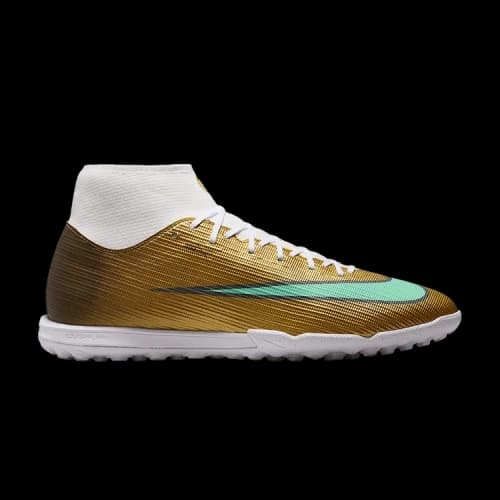
| TF | Turf — the low nubbed sole for short synthetic and hard ground | IR0787-701 |
| MG | Multi-ground — a mixed stud pattern intended for several surfaces | IF8517-600 |
| IC | Indoor court — a flat, non-marking sole for futsal and indoor courts | HQ2319-200 |
| IT | Indoor — the same flat-sole idea, as our catalogue writes it on one family | 106696-02 |
Two of those are worth a closer look because they are the ones people get wrong. TF is not a cheaper FG: it is a different sole for a different surface, and a boot sold on TF will be uncomfortable on a full grass pitch in a way no amount of breaking in fixes. And FG/MG is not two boots; it is one plate the maker sells as suitable for both, which is why it appears in the name as a pair of codes rather than as one. If you play on one surface almost all the time, buy for that surface. If you genuinely split your weeks between two, FG/MG is the compromise the catalogue actually offers you.
Which plates the boots we carry come on
This is the part that decides what you can actually buy today. Across the boots named in this article, FG is the plate most of them share — nine of the pairs here carry it, counting the two player-edition runs and the Premier. TF and MG follow, with four and two. AG turns up on three, all of them Mercurial or Phantom Academy builds. SG is represented by a single pair, IC by one, IT by one. That distribution is not a judgement about which plate is best. It is what the shops we check have chosen to buy, and it tells you which surface the market is being served for right now.

The families those boots belong to
Seven families account for the boots we hold, across three brands. The table gives each family, the plate codes that appear in the names we carry for it, and one code you can look up directly. Note that the plate codes are not shared out evenly: Mercurial and Phantom between them cover six of the eight codes, while the Premier is an FG-only line in our catalogue.
Every family in this table is one we hold at least one pair of, and every example code is a pair with its own page.
| Family | Brand | Plate codes in the names we hold | An example code |
|---|---|---|---|
| Mercurial Superfly 11 | Nike | FG, FG/MG, AG, TF | IR0786-701 |
| Mercurial Vapor 17 | Nike | FG, MG | IF8517-600 |
| Phantom 6 | Nike | TF, MG, IC, AG | HJ4123-600 |
| Premier 3 | Nike | FG | HM0265-003 |
| Predator | adidas | FG, AG, SG | KK4187 |
| Copa Pure IV | adidas | FG, TF | KI0627 |
| F50 | adidas | FG | KJ3432 |
| King | PUMA | IT | 106696-02 |
Two more things worth noticing. The first is that the same model name is used at several price levels — Club, Academy, League, Pro, Elite — and the plate code is written the same way at every level, so an Academy FG and an Elite FG are the same surface even though they are very different boots. The second is that the children's pairs in our catalogue follow exactly the same naming: a (GS) boot carries its plate code in the same place, so you can buy for a child using the same two letters you would use for yourself.
Sizing: why the two charts disagree
Boots are where our two biggest size charts most visibly disagree. adidas writes European sizes in thirds — 40, 40 2/3, 41 1/3 — while Nike writes them in halves. Put the two side by side at the European numbers both charts carry and something surprising comes out: they agree on the American size and disagree by half a size on the British one.
Both charts as we publish them, at the four European numbers they have in common. The numbers are the charts and are not translated, including the one Nike writes as 6 (40).
| EU | UK on the adidas chart | US on the adidas chart | UK on the Nike chart | US on the Nike chart |
|---|---|---|---|---|
| 40 | 6.5 | 7 | 6 (40) | 7 |
| 42 | 8 | 8.5 | 7.5 | 8.5 |
| 44 | 9.5 | 10 | 9 | 10 |
| 46 | 11 | 11.5 | 11 | 12 |
Read the first three rows and the pattern is consistent: start from the European number, and the American size is the same on both charts while the British one sits half a size apart — adidas reading higher. Then EU 46 breaks it the other way, with both charts agreeing on the British number and the American one moving instead. That is why "I'm a UK 11" is an ambiguous thing to say about a boot and "I'm an EU 44" mostly is not, and why the product page shows you each shop's own numbering rather than a single converted figure.
What to do with this
- Decide the surface first and the colour second. The plate code is in the product name on every boot we carry, so you can filter for it before you look at anything else.
- Treat TF and FG as different boots, not as two grades of the same one. One of them will be wrong for your pitch whichever you pick.
- Convert through the European number when you can. The two charts agree there and disagree on the British column, sometimes by half a size.
- Read the level in the name too — Club, Academy, League, Pro, Elite — because it tells you what the boot is built from, while the plate code only tells you where it is meant to be worn.
Each page names the shops that have the pair and shows today's offers, in that shop's own size numbering. The plate code, the level and the sizes are all on the page — nothing here is a figure we wrote down once and forgot to update.