Data / Study
· 29 November 2026
Buying sneakers on resale platforms costs less than a few years ago: the typical premium over the list price fell from 33% in 2022 to 12% in 2025
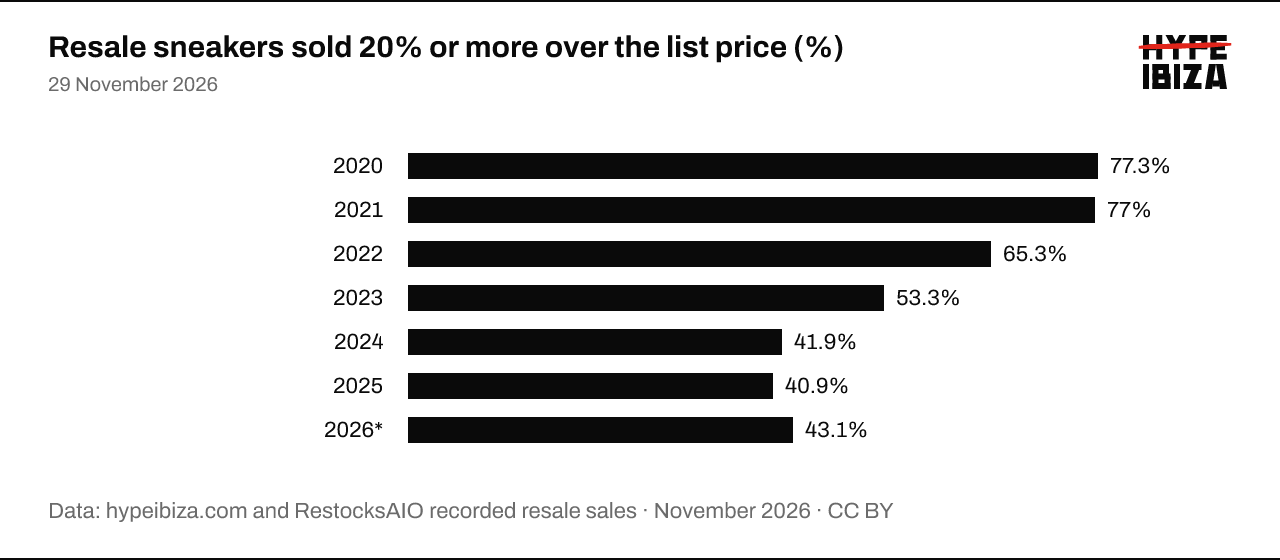
Buyers on resale platforms pay far less over the list price today than a few years ago. In 2022, the typical pair sold for 33% over the US list price; in 2025, for 12%. In 2021 it was even more: 62%, by our estimate. The share of pairs sold 20% or more over the list price fell from at least 61% in 2021 to 41% in 2025. The fall stopped in 2024, and new releases are still dear. These are prices before the buyer's fee, shipping and tax, in sales in US dollars recorded in RestocksAIO.
What we found
Sales in US dollars on resale platforms recorded in RestocksAIO, from 2020 to 27 November 2026. Sale price before the buyer's fee, shipping and tax. 2020 and 2021 are estimates. HYPEIBIZA and RestocksAIO have the same owner.
In 2020 and 2021, buying a pair on resale nearly always cost far more than its list price. At least 61% of the pairs of 2021 sold for 20% or more over it: that is the part where the seller's payout alone was over that level, before any fee. With the fees that the marketplaces charge today, the estimate is 77%, with an interval of 63% to 89%.
The premium fell each year until 2024. The share of pairs sold 20% or more over the list price went to 65% in 2022, 53% in 2023 and 42% in 2024. The median pair fell from 62% over the list price in 2021 to 14% in 2024. In 2025 it stayed at 12%, with 41% of pairs over the 20% line. In 2026, to 27 November, it was 43%: it has not fallen again.
New releases do not follow the same curve. Of the sneakers sold within 90 days of release, 89% sold for 20% or more over the list price in 2021. In 2023 the share fell to 46%, but in 2025 it rose to 54%, with the median pair 22% over the list price. A buyer of a new release on resale still nearly always pays more than at the shop.
By brand, the fall is clear for Nike, Jordan and Yeezy. For Nike, the share over the 20% line went from 72% in 2021 to 31% in 2025; for Jordan, from 86% to 30%. adidas without Yeezy went the other way: from 21% to 34%, with the wave of the Samba and the Campus. ASICS had 55% in 2025.
It is one measurement seen from two sides. The sale price comes from the payout to the seller and the marketplace fee, so the fall of the premium and the fall of the reseller's payout are the same data. The restock.gg study tells it from the reseller's side: the pairs that paid out 20% or more over the list price fell from 61% to 20%.
By year: what the buyer pays and what the reseller receives
Data of 29 November 2026 · CSVEach year: the share of pairs sold 20% or more over the list price, the share where the payout to the reseller was already over that level (the safe floor), the median price against the list price and the share sold at or under list. 2020 and 2021 are estimates.
| Year | Sold 20% or more over list (%) | Payout to the reseller 20% or more over list (%) | Median price over list (%) | Sold at or under list (%) |
|---|---|---|---|---|
| 2020 | 77.3 | 57.6 | 48.8 | 13.1 |
| 2021 | 77 | 60.9 | 62.4 | 12.9 |
| 2022 | 65.3 | 39.3 | 33.2 | 16 |
| 2023 | 53.3 | 26.4 | 22.7 | 22.5 |
| 2024 | 41.9 | 20 | 14.4 | 33.7 |
| 2025 | 40.9 | 20 | 12.4 | 37.4 |
| 2026 | 43.1 | 21.8 | 14 | 34.3 |
Swipe the table to see every column.

Sneakers sold within 90 days of release
Data of 29 November 2026 · CSVThe same measures for sneakers sold within 90 days of release. Since 2023 they have not fallen.
| Year | Sold 20% or more over list (%) | Median price over list (%) | Sold at or under list (%) |
|---|---|---|---|
| 2020 | 85.6 | 50.1 | 3 |
| 2021 | 89.2 | 65.4 | 2.1 |
| 2022 | 59.7 | 26.2 | 15.5 |
| 2023 | 45.6 | 16.8 | 24 |
| 2024 | 47.1 | 18 | 21 |
| 2025 | 54.2 | 22.2 | 19.4 |
| 2026 | 51.1 | 20.5 | 18.7 |
Swipe the table to see every column.
By brand, 2021 and 2025
Data of 29 November 2026 · CSVBy brand, in 2021 and 2025, with 300 or more sales per cell. A brand also reflects which models were resold: the adidas figure follows the Samba and the Campus.
| Brand | 2021: sold 20% or more over list (%) | 2025: sold 20% or more over list (%) | 2021: median price over list (%) | 2025: median price over list (%) |
|---|---|---|---|---|
| Nike | 72.4 | 31.1 | 69.8 | -1.8 |
| Jordan | 85.7 | 29.9 | 43.1 | 1.4 |
| Yeezy | 92.3 | 53.3 | 93.7 | 56 |
| New Balance | 89.5 | 40.7 | 84.8 | 13.6 |
| adidas | 20.8 | 34.4 | -16.3 | 3.2 |
| ASICS | – | 55.1 | – | 22 |
Swipe the table to see every column.
The resale premium fell until 2024, then stopped
Share of pairs sold for 20% or more over the list price, by year. 2020 and 2021 are estimates; 2026 runs to 27 November.
What it means for you
Before you buy on resale, check the list price and whether the sneaker is still in shops. Today more than a third of resale pairs sell at or under the list price, before fees and shipping.
If you want a new release, resale is still dear: in 2025, more than half cost 20% or more over the list price. Also compare the marketplace's fee and shipping, which are not in these figures.
Cheaper than in 2021, not at shop price
For a buyer on resale, sneakers today cost far less over their list price than in 2021, and for a reseller, the big margin is rare. But the fall stopped in 2024, and a new release on resale still costs more than at the shop in most cases.
The reseller's side, from the same data, is in the restock.gg study of resale payouts.
What the data cannot tell you
The data are the sales in US dollars on StockX and Alias that sellers record in RestocksAIO, mostly professional resellers in Europe; they are not the whole market, and there is no euro figure. The list price is the US price, without tax; in Europe it is usually the same number or higher.
The sale price does not include the buyer's fee, shipping or tax: what a buyer pays is higher. We estimate it from the payout to the seller with the fee measured in 2022 to 2026; before 2022 we assume the same fee, so 2020 and 2021 are estimates and we give the safe floor. 2019 is out because it has few sellers.
We do not measure the same models in every year: the mix of models and sizes changes. A brand also reflects which models were resold.
HYPEIBIZA and RestocksAIO have the same owner. The study says nothing about how StockX or Alias work: it measures recorded sale prices.
Method
Resale sales in US dollars on StockX and Alias recorded in RestocksAIO, from 2020 to 27 November 2026, footwear only, with a list price of 40 to 600 dollars. Sale price = payout to the seller / the part the marketplace pays out (median 2022-2026: 0.833 on Alias, 0.869 on StockX). Each figure comes from 10 or more sellers; a brand from 300 or more sales. 95% intervals by resampling sellers.
Full methodologyHow to cite
HYPEIBIZA, "Buying resale sneakers costs less: the typical premium fell from 33% to 12%", 29 November 2026, https://hypeibiza.com/data/resale-prices
The figures, tables and charts are free to use for press and blogs, with credit to HYPEIBIZA and a link to the study page.
Press contact
For figures by segment, another date or a question about the method: hello@hypeibiza.com